
How our original GIF collection is made
Published by Optimalium LLC · How we check our work · Report a correction
See how the collection combines geometric artwork, fixed text and an encoder, and what its origin claims do and do not mean.
What is original about the collection?
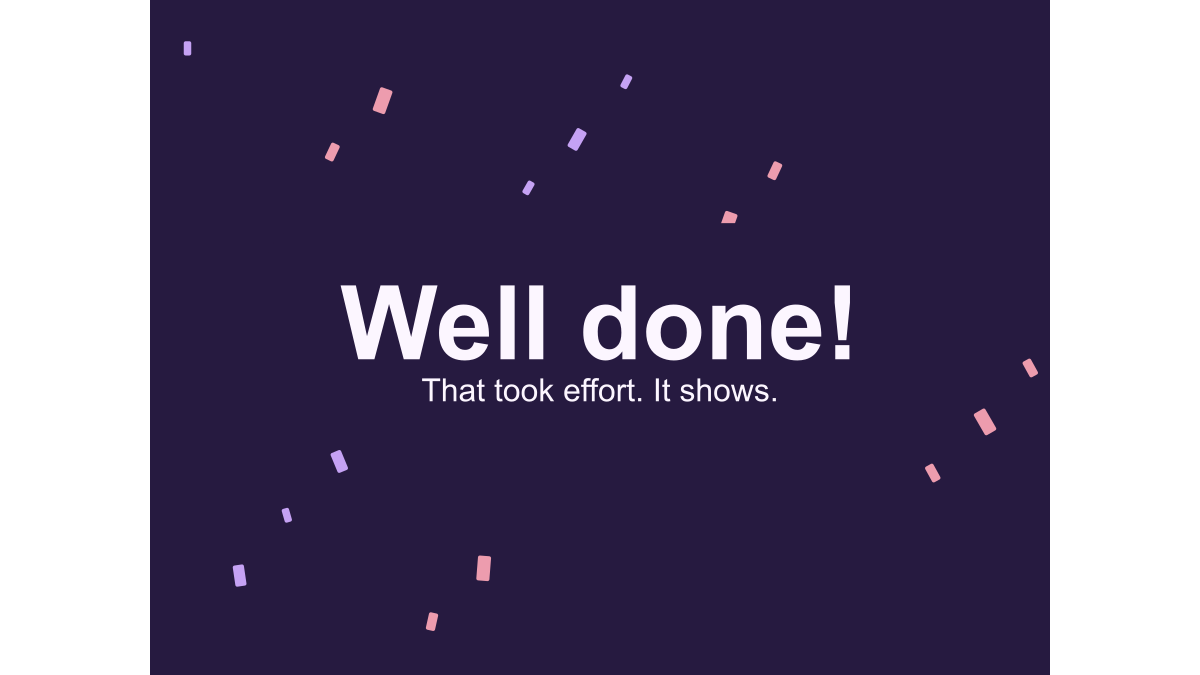
Each published greeting has its own wording, palette and movement choice within a shared drawing system. The system creates circles, an oval, confetti rectangles or curved waves. These shapes are drawn for this project rather than extracted from someone else’s animation. The Well done card shows how the fixed message and moving decoration fit together.
The collection and articles were created with AI assistance. We do not claim that a named illustrator hand-drew them, that a human editorial team tested them with millions of visitors, or that the site has a partnership with a GIF platform. “Original” describes how these particular files were produced; it is not a guarantee that no other person has ever used a similar phrase, colour or geometric arrangement.
How does a drawing become an animation?
The renderer first describes a single frame as SVG: text, positions, fills and outlines. It repeats that operation for 24 phases of the movement. During generation, each SVG is rasterized into pixels, the colours are reduced to a palette, and the pixels are encoded as a GIF frame with a delay.
The browser maker uses the same drawing rules but renders through the visitor’s browser. Published collection files are generated during development. Fonts and rasterization may differ between environments, so two exports with the same wording can have slightly different edges and file sizes. The timing guide explains how the movement closes into a loop.
Why not import thousands of reaction GIFs?
A large catalogue would not by itself explain who owns each image, whether the source permits redistribution or what a reader can do with it. This collection deliberately provides a small set of traceable assets alongside practical controls: a still alternative, exact file details and a way to personalize the message.
An externally hosted image is not automatically free to republish because its URL is public. A search result or a third-party download button also does not establish a license for an unrelated website. When adding future material, its source and permission would need to be checked for that material, rather than inferred from the current collection.
What can you reuse?
The collection is offered for personal greeting messages. Linking to a card or article is welcome. We do not grant a blanket commercial license, permission to resell a pack or permission to claim authorship of the articles. A custom message can introduce someone else’s name, brand or text, and the maker cannot determine whether you have permission to use it.
The website template and GIF encoder have their own open-source software licenses. Those licenses cover the respective software and should not be confused with a license for every image found on the web. The credits page names the components. Our editorial policy explains measurement, correction and authorship practices without inventing credentials.
Related Articles
guides
Change GIF speed: same pixels, three measured timings
Download a 24-frame GIF at three speeds. Compare exact bytes, inspect timing, and learn when a uniform delay will remove pauses you need.
guides
One greeting, three layouts: compare real GIF downloads
Compare centered, portrait and postcard greetings using nine real GIF and PNG files, measured bytes and a repeatable browser workflow.
guides
Fix a GIF export: small text, missing downloads and still images
Troubleshoot this browser GIF maker with reproducible checks for small lettering, cancelled exports, stale files and animation that becomes still.
Was this helpful?
Thanks for the feedback!